Showing posts with label Mad. Show all posts

Wednesday, September 8, 2010

Blackhawk Wingsdays Presents "The Black and Blue Hawks!"

The postwar popularity of the Blackhawks sort of confuses me. Comics audiences lost interest in most war-oriented series soon after World War II ended, but Blackhawk remained successful even beyond the demise of its first publisher, Quality Comics.

And it remained successful without evolving very much. The team still fought Orientalist villains and Nazis who survived the war and planned a return of the Reich. Not much later, they became cold warriors and stopped Communist insurgencies in real and fictional nations. And Chop-Chop remained a caricature that had to be offending someone by then.

In my Blackhawk research, I have not found much contemporaneous criticism of the series's politics or racial problems. The exception, though, is the parody of Blackhawk that appeared in Mad 5 (June-July 1953), "The Black and Blue Hawks!" drawn by Wally Wood, with writing credit not given (though I have seen Harvey Kurtzman credited at times). In the typical Mad fashion, this is a biting, hilarious parody which really nails the source's many problems.

To begin with, they parody the Blackhawks fight song: "Over land, over sea, we-ee fight for do-re-mi ... ha cha cha, we're Black and Blue Hawks!"

The team is introduced as Saddlesore (Chuck), Sauerbratten (Hendrickson), Yohnson (Olaf), and Chop Chop Chop. The latter might be the most insightful part of the parody. He's so small that he's in danger of being trampled on at all times, and instead of the usual broken English, he speaks like this:


He's also the only competent member of the group. But despite that, he's given a wind-up toy named "H.M.S. Pinafore" as a plane.

After this introduction, Robespierre (Andre) crashes on the island, bringing news of a revolution in "Panazonia" with his last breath. From here on, the story effectively parodies the comics' tendency to show the team propping up third-world dictatorships.

Chop Chop Chop is always saving Black and Blue Hawk after the latter screws up in some way, leading to Chop Chop Chop actually carrying the oaf on his back after their plane crashes into the ocean:
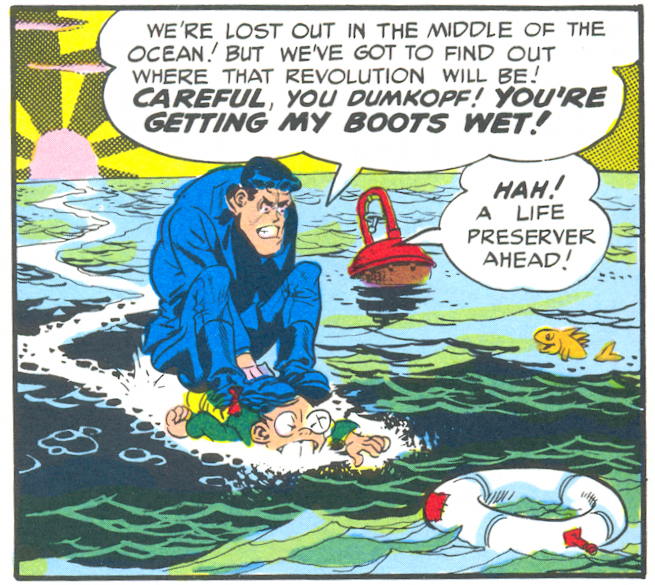


I love that Black and Blue Hawk slips into German here.

When they discover that only one life-preserver is available, the leader shows his true colors:


This is where the parody gets truly brutal. The line "You're not really one of us!" effectively encapsulates the entire treatment of Chop-Chop over the previous eleven years or so: despite his participation on the team, he is always treated as separate and different. It's hilarious, but like the best Mad parodies, it goes way beyond that, making an insightful and painful critique of the subject at hand.

This parody also gives the sense that there was also someone else out there who thought that Blackhawk was problematic, to say the least. Not only that, but the series was also popular enough to fall within the radar of the Mad creators and readers. Nonetheless, even this parody had little effect on the status quo at the Blackhawk series, and it would be a few years before Quality would even begin to change something like the appearance of Chop-Chop.

Special thanks to Mike Sterling of Mike Sterling's Progressive Ruin for help with the scans.

Friday, May 16, 2008

Will Elder, RIP

The passing of Will Elder, one of the founding artists on Mad ("The Usual Gang of Idiots") and one of the greatest humorists in comics, at the age of 86 was reported earlier in the week.

Like a lot of kids growing up in the 70s, I was an avid reader of Mad magazine, even starting a subscription in 1976 for my seventh birthday (I remember sending, along with the subscription form, a handwritten letter that, unfortunately, never got printed on the letter page. I don't remember the exact story to which I was responding, but I do remember that the letter was one sentence long, structured on a gag common to Mad's letter page: "[Mad's parody] was funnier than [something with a similar theme that was not funny at all]." For example, "Your Godfather parody was funnier than the St. Valentine's Day Massacre." Whatever my joke was, it has been lost to time and memory, but I do know for a fact that it was painfully unfunny. My parents even told me so before I sent it off.).

I was especially fond of the large sized Mad Super Specials common at the time, which usually contained facsimile reprints of the early Mad comics, labelled "Nostalgic Mad." It was in these reprints that I got my first taste of Will Elder's humor, and the memory of his stories still linger long after most of those comics have gone from my collection.

I had been reminded of Elder's work recently while reading David Hajdu's The Ten-Cent Plague, where Elder's work in the early days of Mad is detailed. Hajdu's description of Elder's technique helps explain why his art still stays with me even 30 years after I've read some of the stories:
[Mad editor Harvey] Kurtzman set his old friend loose at Mad, and Elder overran the pags with bits of lunatic business--unscripted little stories within stories, visual non sequiturs, kooky details. In the opening panel fo Elder's one contribution to the premiere issue of Mad ("Ganefs!"), Elder added no fewer than three dozen sight gags not in the script. (The number increases each time one counts.)


Here's a good example: the splash panel of Kurtzman and Elder's parody of The Shadow from the fourth issue of Mad:

This panel is worth studying carefully just for the sheer number of jokes and sight gags thrown into it. Every time I look at it, I find something else that I hadn't noticed. Of particular note, though, is the television on a shelf in the upper right corner of the panel, tuned into the "Kefauver Crime Committee." This minor gag was aimed at the popularity of the committee's telecasts, which were already more than a year old when this story was published (Elder would also take a shot at the Kefauver Committee in the very first issue of Mad as a magazine).

The gag takes on considerable historical and ironic significance today, however. The committee on juvenile deliquency that opened up the investigation which eventually caused Mad's publisher, William Gaines of EC Comics, to get out of the comic business was an offshoot of Kefauver's committee, this one led by Richard Clendenen, though Estes Kefauver was also a member. Kefauver famously confrontated Gaines over a Crime SuspenStories cover by Johnny Craig featuring a man holding an axe in one hand and a woman's head in the other--a moment that became a rallying point for the anti-comics movement in the mid-1950s.

This story is also a great example of the still-surprising black humor that came out of Kurtzman's and Elder's collaborations. Throughout most of the story, The Shadow remains invisible due to his ability to "cloud men's minds." One thug in the bar, however, gets the drop on The Shadow:

I only just noticed while scanning that the sound effects in the second panel are reflected in the mirror.

The appeal of this joke, and of Elder and Kurtzman's work in general, is it's transgressive nature. It's just plain wrong, and the dialogue and imagery celebrate that fact unashamedly.

On the next page, The Shadow's companion, Margo Pain (instead of Margo Lane), gets kicked down the stairs, and Elder even used the stairs themselves to throw in some non sequitur gags that parody contemporary ads.

When The Shadow does reveal himself to Margo on that same page, we get another classic example of Elder's style in Margo's facial reaction:

The jokes that run throughout this story, and in most of Elder's Mad material, are often violent and sexual in ways that still might surprise readers more than half a century later, and they are still laugh-out-loud funny. The story ends with a nice EC twist: The Shadow, who has been secretly trying but failing to kill Margo all along, succeeds with the an obvious death trap, and then celebrates her demise.

Like generations of readers over the last 50 years (I was, in fact, a second-generation Mad reader), I had my sense of humor warped by Will Elder's and others' work on Mad, and for that I am grateful.