Showing posts with label Wally Wood. Show all posts

Wednesday, September 8, 2010

Blackhawk Wingsdays Presents "The Black and Blue Hawks!"

The postwar popularity of the Blackhawks sort of confuses me. Comics audiences lost interest in most war-oriented series soon after World War II ended, but Blackhawk remained successful even beyond the demise of its first publisher, Quality Comics.

And it remained successful without evolving very much. The team still fought Orientalist villains and Nazis who survived the war and planned a return of the Reich. Not much later, they became cold warriors and stopped Communist insurgencies in real and fictional nations. And Chop-Chop remained a caricature that had to be offending someone by then.

In my Blackhawk research, I have not found much contemporaneous criticism of the series's politics or racial problems. The exception, though, is the parody of Blackhawk that appeared in Mad 5 (June-July 1953), "The Black and Blue Hawks!" drawn by Wally Wood, with writing credit not given (though I have seen Harvey Kurtzman credited at times). In the typical Mad fashion, this is a biting, hilarious parody which really nails the source's many problems.

To begin with, they parody the Blackhawks fight song: "Over land, over sea, we-ee fight for do-re-mi ... ha cha cha, we're Black and Blue Hawks!"

The team is introduced as Saddlesore (Chuck), Sauerbratten (Hendrickson), Yohnson (Olaf), and Chop Chop Chop. The latter might be the most insightful part of the parody. He's so small that he's in danger of being trampled on at all times, and instead of the usual broken English, he speaks like this:


He's also the only competent member of the group. But despite that, he's given a wind-up toy named "H.M.S. Pinafore" as a plane.

After this introduction, Robespierre (Andre) crashes on the island, bringing news of a revolution in "Panazonia" with his last breath. From here on, the story effectively parodies the comics' tendency to show the team propping up third-world dictatorships.

Chop Chop Chop is always saving Black and Blue Hawk after the latter screws up in some way, leading to Chop Chop Chop actually carrying the oaf on his back after their plane crashes into the ocean:
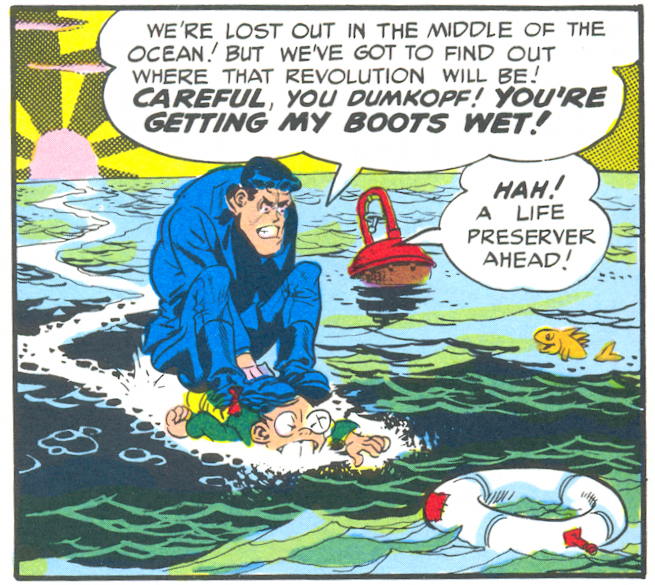


I love that Black and Blue Hawk slips into German here.

When they discover that only one life-preserver is available, the leader shows his true colors:


This is where the parody gets truly brutal. The line "You're not really one of us!" effectively encapsulates the entire treatment of Chop-Chop over the previous eleven years or so: despite his participation on the team, he is always treated as separate and different. It's hilarious, but like the best Mad parodies, it goes way beyond that, making an insightful and painful critique of the subject at hand.

This parody also gives the sense that there was also someone else out there who thought that Blackhawk was problematic, to say the least. Not only that, but the series was also popular enough to fall within the radar of the Mad creators and readers. Nonetheless, even this parody had little effect on the status quo at the Blackhawk series, and it would be a few years before Quality would even begin to change something like the appearance of Chop-Chop.

Special thanks to Mike Sterling of Mike Sterling's Progressive Ruin for help with the scans.

Tuesday, October 20, 2009

Halloween Countdown Day 20: Gil Kane Style 3!

Following "Comes a Warrior" in House of Mystery 180, readers were treated to a second Gil Kane story, which seemed to be commenting on the previous one. "His Name Is ... Kane!" written by Mike Friedrich and inked by Wally Wood, tells the story of an egotistical comic artist named "Gil Kane," who is too good for the work he is given, and to punish his hubris, he is pulled into his own art!

Kane often drew himself into his stories, especially Silver Age Green Lantern and Atom stories, where Kane would suddenly appear at his drawing board, giving the reader some information during a pause from the action. Here, though, he's clearly letting the piss get taken out of himself for this story.

There's a nice little detail on the splash page, where, in the background, we can see a signed portrait on the wall that reads, "To Gil From Eli." Of course, "Eli Katz" was Gil Kane's real name, so the implication here is that he signed this portrait to himself.

Kane is sucked in to his own story, where he has to do battle with some of the crazy beasts he's created, including what looks like the dragon from the previous story. However, he grabs onto Rangarry's sword and battles the beasts on his own. And while Kane does draw himself as one of his signature screaming floating heads, he does not draw himself delivering a patented Gil Kane Punch, which is the one disappointment in this otherwise awesome story.

The story then flashes back to an earlier time, where editor Joe Orlando is chastising Kane for being late 13 times in a row.

Kane's complaints about his inkers may have been based on real events, as Kane was never very happy with the inkers he had while working for DC in the Silver Age, including Sid Greene and Vince Colletta. However, I can't imagine Kane was dissatisfied with Wally Wood's inks on this or the previous story, as Wood's inks complemented Kane's pencils better than any other inker but himself. And this reference to Kane making it big as a publisher references Kane's failed attempt at self-publishing the previous year, the the awesome comic magazine His Name Is ... Savage! (hence, this story's title as well).

Looking to get away from these harrassing phone calls, Kane finds a quiet place to work at the House of Mystery, where the host, Cain, has a studio already set up for him.

However, Kane can't even find any peace here. as Orlando tracks him down, and they have it out.


I particularly love this reference to Kane's "research for [his] private outside character"--the hyperviolent Savage--which leads Kane to kill Orlando and dispose of the body, causing him to get further behind on his deadlines.

Kane wakes up from an exhausted nap at his drawing board to find a team of small, balding assistants working independently on his art.


(I'm thinking that these miniature assistants are meant to look like DC publisher and former Kane studio-mate Carmine Infantino, but I may be wrong here.)

The artist is then sucked into the page, where he faces a new set of demons, who look a bit like Joe Orlando and Mike Friedrich.

The story ends with Cain entering the studio and finding it empty. Left on the drawing board, however, is an awesome piece of Gil Kane original art, which Cain quickly frames and hangs on the wall, trapping Kane beneath the glass forever!

I've always wondered what the story is behind this story. Kane had to have a good sense of humor to participate in this, yet a lot of the digs at him seem pretty genuine. In a late interview that Gil Kane did with Gary Groth for Comics Journal, Kane suggests that this story, titla and all, was written before he was signed on as artist, but I find it hard to believe that Joe Orlando would have gone with a different artist on it. Still, if anyone out there knows any more about the genesis of this story, I'd be interested in hearing about it.

Tuesday, October 6, 2009

Halloween Countdown Day 6: Gil Kane Style!

During the Halloween Countdown, I'm going to change up the Gil Kane Punch feature. Instead of just showing a specific punch, I'm going to cover a horror comic that Gil Kane drew. And often, these don't involve punching, but they are still awesome.

The first one is titled "The Eyes of the Basilisk," from House of Mystery 184 (the same issue that featured Alex Toth's story "Turner's Treasure"), written by E. Nelson Bridwell and inked by the great Wally Wood. "The Eyes of the Basilisk" demonstrates that dynamic art can elevate an otherwise mediocre story.

The tale opens in the mythical kingdom of Karinek, where four young herdsmen named Dikon, Jalk, Adro, and Wark are lazing about in a field while their cattle roam free. Suddenly, the cattle are all killed by a frightening, serpent-like creature known as a Basilisk, which has the ability to kill with its gaze.


Three of the stupidly named characters are killed by the Basilisk, while Jalk gets away to warn the rest of the kingdom of the serpent's attack.

The creature terrorizes the town to the point that the king, Lundru, consults his "chief wise man," Canthros (Jesus, I hate these stupid fantasy names). Canthros explains to the king that, while he may have 99 problems, the Basilisk ain't one.


Actually, the Basilisk is one of only two problems the king apparently has, the other being an unmarried daughter, Princess Adeen. Canthos explains that Lundru can kill two birds with one stone: offer the princess as the prize for defeating the Basilisk. Coincidentally, this is exactly how I solved a landscaping problem I had earlier this summer.

Word gets out that any man who kills the Basilisk will score a hot princess, so a bunch of douchebags give it a shot, and they all fail.

Eventually, word of the challenge gets to "Dursus the Clever" and his brother, "Ulfar the Afflicted." It sucks enough being the brother of Dursus the Clever, but then to be stuck with the epigram "the Afflicted," especially when no one goes on to explain what the affliction actually is. It leaves too much to the imagination.

Dursus decides that all the other men failed because they weren't clever enough, and he devises a plan where he will use a polished shield to serve as a mirror, so he doesn't have to look directly into the Basilisk's eyes.

This plan does not work at all.

So, who's the clever one now?

Ulfar is stricken with grief at the loss of his no-longer-clever brother, and he decides to take on the Basilisk in order to get revenge, despite the "affliction." Ulfar then uses a mirror to shine in the Basilisk's eyes, thus turning the deadly gaze back on the creature.

The Basilisk dies, and as promised, Ulfar gets the hand of Princess Adeen. Adeen is excited because Ulfar turns out to be pretty hot himself. He then goes on to explain why he was especially suited to defeating the creature, which gives us the story's ironic twist:

Quietly, the king replaces Adeen with his even-more-unmarriable daughter, Ugleen.

But seriously, Wally Wood's tight inks on Gil Kane's pencils are just fantastic here, and the Basilisk itself looks pretty awesome. Kane did a lot of work for the DC mystery titles in the late 60s and early 70s, even though the bulk of his work at the time was done for Marvel. We'll be picking up some more of these great stories in the coming weeks.

Sunday, May 24, 2009

Dr. K Reviews: Blazing Combat!


Holy crap, this book is awesome!

In 1965, Warren Publshing sought to build on the success of their horror comic magazine Creepy. Since Creepy was modeled after the the EC horror comics of the previous decade, the decision was made to duplicate another famous EC genre: war comics. The result was Blazing Combat, written by Archie Goodwin and drawn by some of the greatest artists in comics history, including Wally Wood, Alex Toth, Joe Orlando, Gene Colon, Reed Crandall, John Severin, and Russ Heath.

The series, unfortunately, only ran for 4 issues, and the book spends some time explaining the series's downfall through interviews with publisher James Warren and writer Archie Goodwin. In brief, Goodwin took a critical, realistic approach to war stories, including stories about the Vietnam War, which was then in the early days of American involvement. These Vietnam stories, which anticipated the country's antiwar sentiment, raised the ire of the US military and the American Legion. The military stopped the sale of the comic on all military bases and the American Legion encouraged wholesalers to keep it from newstands. Thus, after only a few issues, Warren had to pull the plug.

What made it into these four issues, however, are some of the greatest war comics ever made. In reading this collection, I was struck not only the progressive attitude toward war that these stories present, but also the breadth of stories told here. Each issue includes stories ranging from the American Civil War to Vietnam, and, with the exception of World War II, rarely is a historical period repeated in an issue. Each issue contained 7-8 short stories. When these stories are presented collectively like this, Archie Goodwin's accomplishment here can be seen as on par with Harvey Kurtzman's work on the EC war books.

I was also amazed at how well these stories hold up after more than 40 years. Warren published its comics as magazines in order to circumvent the censorship of the Comics Code, so while the level of violence depicted here may be higher than that acceptible in mainstream comics of the time, it is by no means gratuitous. The Vietnam stories are probably the most remarkable. The opening story of the series, "Viet-Cong" (with art by Joe Orlando, who draws most of the Vietnam stories) features an American soldier advising the South Vietnamese army and witnessing the murder of civilians and the torture of enemy soldiers (including waterboarding).

If anything unifies these stories, other than the focus on war, it is a dominant sense of irony. Stories of military heroism are rare, and when they do occur, they are often balanced by this irony--in one Revolutionary War story, the heroism of an unnamed general is celebrated, and we only find out at the end that it's Benedict Arnold.

Among my favorite stories are those involving fighter pilots in various wars, especially those stories drawn by Alex Toth and Wally Wood. Toth drew what is probably my all-time favorite war comic story--"F-86 Sabre Jet!" in EC's Frontline Combat 12. Toth's "Lone Hawk" and "The Edge!" are easily on par with that earlier story, and "The Edge!" itself forms a perfect companion piece, where Toth uses a deceptively minimalist style to tell a gripping story of Korean War fighter combat. Wally Wood did two amazing fighter pilot stories: "The Battle of Britain!" (which he wrote--the only story in the collection not written by Goodwin) and "ME-262!" The latter story is especially remarkable because it tells of the frustration of a German pilot in WWII who knows that the new Messerschmitts should be used as fighters, while Hitler keeps insisting on making them bombers.

Probably my favorite story in the collection, however, is "Give and Take," with art by Russ Heath. Heath has always been one of the greatest war comics artists, but this story goes well beyond any of the work he did in DC and Atlas's war comics. The art is almost photo-realistic here, especially in the use of shadows and evocative facial expressions.

In all, this is an essential collection, featuring truly important stories from an unfortunately brief period of incredible creativity on the part of Archie Goodwin and a stable of some of comics' greatest artists. Fantagraphics has been knocking out a lot of great archival collections lately, including Paul Karasik's rediscovery of Fletcher Hanks's work, Craig Yoe's collection of bizarre Boody Rodgers stories, Greg Sadowski's Supermen anthology, and the complete, essential collection of Harvey Kurtzman's Humbug series (not to mention the work they are doing on comic strip archives).

Tuesday, May 5, 2009

The Gil Kane Punch of the Week 2


Robin punches Sebastian Sepastopol in "Stepping Stones for a Giant Killer," written by Mike Friedrich, pencilled by Gil Kane, and inked by Wally Wood. Originally published in Teen Titans 19 (1969) and reprinted in Showcase Presents: Teen Titans Vol. 2.