Monday, October 4, 2010

More Ask Doctor K!

I've recently received a letter from my faithful young reader, who asks a question so important that I had to answer it immediately:


Dear Young Reader:

First of all, thank you for the letter. Letter writing is a dying art form, so I'm glad that you are helping to keep it alive. I was very excited to see your letter in the mailbox alongside bills, solicitations for new phone service, and information about local politicians running in the upcoming elections.

Also, I love you a bushel and a peck, too, which, from what I understand, is a significant amount.

I felt that your question was of the utmost importance because it gets at the heart of something very important: that Batman is better than all of us, so he does not need the normal things we need in our day-to-day lives, like keys to start cars.

And by "car," I assume you mean "Batmobile." Though I would guess that Batman could pretty much start any car without a key because he's Batman.

So, let's take a look at what happens here, when the nasty Joker tries to steal the Batmobile and make a getaway:


I included the first panel because that is a pretty awesome kick to the head that Batman delivers, and who doesn't love to see that? That guy is not getting up for a long time.

Then, when the Joker tries to steal the Batmobile, look what happens:


As you can see, the Joker does need a key to start a car, and that is one of the reasons why Batman will always win against the Joker.

In order to show off just how smart he is, Batman reveals to the Joker just how the Batmobile starts without a key:


Notice that Batman's password is "Batman." Little known fact: that is also his ATM code. At first glance, that seems pretty stupid to have your own name be your password, right? (Note to self: change password.) But Batman is really thinking here. A bad guy could break into the Batmobile, and if he figured out that the ignition was controlled by the fake radio, he still wouldn't type in "Batman," because he'd think that Batman wouldn't be stupid enough to use his own name as the password. See how that logic works? Batman is really smart.

Also, Batman doesn't need a radio in his car, mainly because he hates how corporate radio has ruined the medium.

Thanks again for your question, and I would be glad to answer more in the future.

Sincerely,

Doctor K

And I would also like to extend an invitation to all readers out there: if you have or know of young children with pressing questions about superheroes and comic books, please pass them along. I would be happy to answer any that come my way.


(All comic images taken from The Brave and the Bold 111 (Mar. 1974), "Death Has the Last Laugh," written by Bob Haney and drawn by Jim Aparo.)

Saturday, October 2, 2010

Halloween Countdown Day 2: Bloodlust!

I have had a couple of occasions where I've encountered a movie on its own that I had previously seen on MST3K, only to find the movie itself not half bad. One particular example is the 1961 film Bloodlust!


Bloodlust!, written and directed by Ralph Brooke, is one of 1,512 remakes of The Most Dangerous Game. And while it's certainly inferior to the original, I wouldn't hold that against the later film. However, I do have to admit that I have a soft-spot for this plot, where a hunter stalks human prey in a deadly game. In fact, I wouldn't mind if every movie were a remake of The Most Dangerous Game. Especially Eat Pray Love.

So, though Bloodlust! is no Battle Royale, or even Hard Target, it manages to be an effective movie within its budgetary limitations and occasional ridiculousness. Its novelty appeal, which clearly made it game for MST3K, comes from the fact that it stars a young Robert Reed as Johnny, the alpha male leader of a group of four young kids who end up stranded on an island controlled by the insane, megalomaniacal hunter, Dr. Balleau (Wilton Graff). Despite Reed's assertive performance, Johnny is a pretty crappy leader, often making terrible decisions that put the gang in even more danger than they were in before. In fact, whatever success they do have comes more from dumb luck than from Johnny's leadership.

The movie also establishes early on that Johnny is an excellent shot, though he never gets to utilize this talent in the battle against Balleau. His girlfriend, Betty (June Kenney), fares a little better. We learn that she's a judo expert at the beginning of the film, and she does eventually get to flip a dude into a tub of acid, but otherwise I'd count this as a missed opportunity as well.

Balleau is a former WWII sniper who got the taste for killing early in his military career, and he's turned his considerable wealth into this island paradise, where he gets to hunt humans at his leisure. He sets up fairly rigid rules for each hunt, proposing to give his prey an equal and fighting chance against him. For example, his weapon of choice is a crossbow, and he only carries as many bolts as there are prey. He also gives his prey a pistol with one bullet to even the odds. However, the gun doesn't work, and he reuses the crossbow bolts on multiple victims, which is a good way of spreading hepatitis.

The movie's low budget does not prevent it from being surprisingly gruesome at times. Two of the kids stumble acrosS Balleau's lab, where the mute servant Jondor assembles his master's trophies from human skin and body parts. The trophy room itself is pretty cool, too. Each human trophy is arranged in the pose he or she was in just before death. One guy is in a defensive position, with an arrow going through his hands and into his eye. Balleau also has his wife and her lover stuffed in the trophy room, captured in their final embrace.

Even with some of these gruesome moments, the movie has an appealing Scooby-Doo-feel to it. It manages to rise above its limitations, and at a tight 68 minutes, it doesn't overstay its welcome, either. But why take my word for it? You can watch the whole freaking movie right here:

Friday, October 1, 2010

Halloween Countdown Day 1

In past years, I have tried, with varying degrees of success,to do a Halloween blogging marathon during the month of October. I can't say that this year will be any more successful than last, but I'm going to give it a shot. So, check in regularly for posts about horror movies and comics over the next month.

I'd also like to thank the people at the Countdown to Halloween website for organizing all the blogs that are participating in this marathon. If you haven't done so, go over to the site and check out some of the other cool stuff people are doing this month.

To start off, I want to share one of my favorite horror movie scenes, from the 1962 Hammer film, Kiss of the Vampire:


The atmosphere of this scene is perfect, as is the way the tension builds to the final, satisfying payoff. And while that payoff comes as a shock, it's earned through the slow, meticulous build-up.

Keep coming back all month for more of the Halloween Countdown!

Thursday, September 30, 2010

Tony Curtis, R.I.P.

Sad news today that actor Tony Curtis passed away at the age of 85. Most obits today are focusing on his classic comedic performance in Billy Wilder's Some Like It Hot and his Oscar-nominated turn in the barrier-breaking film The Defiant Ones. However, I want to focus on his performance as Sidney Falco in my favorite movie, Sweet Smell of Success.

Sweet Smell of Success has everything going for it: a whip-smart screenplay by Clifford Odets and Ernest Lehman, sharp direction by Alexander Mackendrick, beautiful black-and-white cinematography by James Wong Howe, and top-to-bottom great performances by all the actors involved.

Sidney Falco is a bottom-feeding press agent who barely ekes out a living feeding items on his clients to powerful New York newspaper columnists. In this scene from early in the movie, we see Curtis's frenetic energy that defines the character: he's juggling several problems at once here and trying to look for a way out of all of them.


That energy can also be seen at the beginning of this scene--one of my favorites in movie history--where he's constantly in motion and the camera has to remain mobile to keep up with him. But later, we see press agent Sidney get taken apart by powerful columnist J. J. Hunsecker (Burt Lancaster), yet he manages to maintain his dignity in the face of Hunsecker's abuse.


That dignity wouldn't last, however, as the erosion of Sidney's already low moral standards becomes the crux of the movie. Falco is a sleazeball, but he's never unlikeable, and it's Curtis's performance that maintains such an unlikely balance of revulsion and sympathy. Curtis was at the height of his popularity when he made this movie, and it was a big risk for both him and Lancaster. Curtis was comfortably situated as a Hollywood screen idol at the time, so playing such a morally dubious role in such a dark film could have damaged that position. And the movie failed largely because of its bleak subject matter, but it remains a bold and brutal movie to this day, and a large part of its quality goes to Curtis's fearless, energetic performance.

Curtis would have a rather spotty career, but at his best, he was in some of the greatest movies of all time, all of which were made better for his performances, though he rarely seemed to get the credit he deserved. I also have fond memories, though, of the cool Tony Curtis who appeared on television when I was a kid, especially the underrated adventure series The Persuaders, where he played American oil millionaire Danny Wilde, who teamed up with British aristocrat Brett Sinclair (Roger Moore) on international adventures.

I'm going to spend part of this weekend revisiting Some Like It Hot and Sweet Smell of Success (two movies that I already watch on a fairly regular basis, anyway) to celebrate the career of one of the last classic Hollywood stars.

Friday, September 24, 2010

The Worst Comic Book of All Time

The term "worst comic book of all time" or "worst comic ever" gets bandied about quite a bit, and while there have been some recent strong contenders to that title (make that "one contender"), such assessments lack some historical scope in order to make such a claim.

In my recent research, I have come across the worst comic of all time, and after reading it, I longed for the simple pleasures of a drug-addicted teen sidekick beating people with a dead cat. That would have been infinitely better than what I experienced.

In fact, I kind of find it quaint that some people can read comics their entire lives, only to have Justice League of America: The Rise of Arsenal 3 end up being the worst comic they ever read. I also envy them.

Because, unless there's some lost comic out there written by Hermann Goering and drawn by Adolph Hitler himself, then I cannot imagine a worse comic book than this:


Published by Specialty Book Company of Columbus, Ohio, in 1944, Clean Fun Starring Shoogafoots Jones is a one-shot comic that was apparently popular enough to go through multiple printings, yet it looks like a very cheaply produced, self-published comic. It fails in every conceivable way that a comic could fail: the art and writing (credited to "McDaniel") are amateurish at best, the so-called "jokes" are not funny, and, most important, the book is racist as hell. Plus, it purports to provide moral instruction from something called "Stray Thoughts" by Crump J. Strickland, which is the most Southern name ever this side of Saxby Chambliss. The overt hypocrisy (immediately clear on the cover) of a comic that presents itself as moral instruction while also containing some of the most awful racism imaginable really puts it over the top to be far and away the worst comic book ever made.

In fact, it makes me want to punch the Greatest Generation right in the face.

The book consists of a series of one-page, four-panel gags, loosely tied together by something of a plot that involves Shoogafoots escaping his abusive wife (as seen on the cover), trying but failing to hold down a job, and getting beset by young pranksters who take advantage of his limited intelligence. (Many of these pranksters, by the way, are Shoogafoots children by different mothers, another running gag in the book.) Then, running along the bottom of each page, we get Crump J. Strickland's words of Christian advice, many of which warn against the dangers of introducing immoral "dirt" and "filth" into your mind.

Here is the inside cover and first page of the book. The gag on the inside cover gets extra points for also drawing humor out of a physical disability. The first page sets up the characters for us while also putting the plot in motion:


I would also like to point out that every panel is numbered 1-4, obviously to help the book's target audience, who wasn't yet quite used to the habit of reading from left to right.

Shoogafoots gets a construction job, but he falls off the building and gets fired. He then goes to see a doctor, who beats him and then throws him out. We start to see here a common pattern in Shoogafoots life: failure, followed by abuse at the hands of every authority figure he meets. For example, Shoogafoots later takes a train, and when he asks the conductor if he "know de way," the conductor beats him with a coal shovel. All this physical abuse, especially from his wife, creates a vicious cycle for Shoogafoots: he's abused because he doesn't work, but then his injuries prevent him from working.

And he is also guilty of perpetuating this cycle of violence, as we see on this page, when one of his illegitimate children asks him an innocent, albeit ignorant question that ironically comments on Shoogafoots's own trauma:


And again, bonus points for drawing humor from post-traumatic stress disorder.

On the road, Shoogafoots meets up with Skin Johnson, who has just joined the Army. As it's time for yet another nap, Shoogafoots falls asleep beside a tree and dreams of life in the Army. As a pilot, he bombs the Japanese fleet, but he's shot down and wakes up. Then his wife beats him some more.

We see, however, that Shoogafoots is not incapable of exertion when pressed into it, usually by a prank that capitalizes on his ignorant superstitions, as with this encounter with a ghost:


To the writer's credit, he does not have Shoogafoots shout out, "Feets, don't fail me now!"

In the following incident, Shoogafoots has a run-in with a ill-advisedly placed Halloween skeleton on a junk pile.


We get to see a kind of hierarchy of fear at work by comparing the two above images. A ghost causes Shoogafoots to run 12 miles, while a skeleton causes him to run 14 miles. Also, the skeleton turns him temporarily white, for some hilarious and ironic racial inversion.

The evidence presented here strongly suggests that Clean Fun Starring Shoogafoots Jones is hands-down the worst comic book of all time, as well as proving that human beings pretty much suck in general. It is a demoralizing and angering book to read, not least when one comes across an epigram promoting universal brotherhood appearing underneath a horribly racist joke.

The images here are from photographs I took of the copy I read at the Michigan State University library. That school's excellent comics archive actually has two copies of the comic, both in pretty good shape. Subsequent research shows that this comic is hardly rare, and cheap copies can be found for a comic from 1944. This leads me to believe that the book was fairly successful for the Specialty Book Company, which is again saddening.

Thursday, September 16, 2010

The Gil Kane Punch of the Week 41: I Bend Steel and I Break Braggarts!

DC Comics Presents Annual 3 (1984) is the gift that keeps on giving ... punches, that is! When is it going to stop?


As usual, plot by Roy Thomas, script by Joey Cavalieri.

Wednesday, September 15, 2010

Blackhawk Wingsdays Presents: Sketchbook Time!

It's going to be a light week for Blackhawk Wingsdays, but I did want to start sharing some of the Blackhawk sketches I've recently received. Starting at HeroesCon this year, I decided to begin a Blackhawk sketchbook. Now, I've never done a sketchbook before, so I was a bit trepidatious. Luckily, everyone I've asked so far has been gracious.

Here's the first one I wanted to share, by Jeff Parker:


Jeff Parker, who is a great writer and a swell guy, really nailed this sketch. When I asked him at HeroesCon if he'd do a Blackhawk sketch, he grabbed the book and said, "I'm doing Hendrickson!" This cracks me up every time I look at it.

Wednesday, September 8, 2010

Blackhawk Wingsdays Presents "The Black and Blue Hawks!"

The postwar popularity of the Blackhawks sort of confuses me. Comics audiences lost interest in most war-oriented series soon after World War II ended, but Blackhawk remained successful even beyond the demise of its first publisher, Quality Comics.

And it remained successful without evolving very much. The team still fought Orientalist villains and Nazis who survived the war and planned a return of the Reich. Not much later, they became cold warriors and stopped Communist insurgencies in real and fictional nations. And Chop-Chop remained a caricature that had to be offending someone by then.

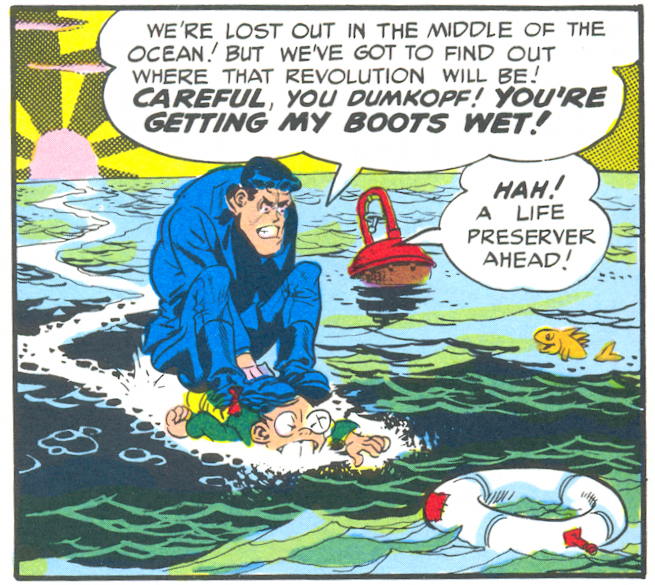
In my Blackhawk research, I have not found much contemporaneous criticism of the series's politics or racial problems. The exception, though, is the parody of Blackhawk that appeared in Mad 5 (June-July 1953), "The Black and Blue Hawks!" drawn by Wally Wood, with writing credit not given (though I have seen Harvey Kurtzman credited at times). In the typical Mad fashion, this is a biting, hilarious parody which really nails the source's many problems.

To begin with, they parody the Blackhawks fight song: "Over land, over sea, we-ee fight for do-re-mi ... ha cha cha, we're Black and Blue Hawks!"

The team is introduced as Saddlesore (Chuck), Sauerbratten (Hendrickson), Yohnson (Olaf), and Chop Chop Chop. The latter might be the most insightful part of the parody. He's so small that he's in danger of being trampled on at all times, and instead of the usual broken English, he speaks like this:


He's also the only competent member of the group. But despite that, he's given a wind-up toy named "H.M.S. Pinafore" as a plane.

After this introduction, Robespierre (Andre) crashes on the island, bringing news of a revolution in "Panazonia" with his last breath. From here on, the story effectively parodies the comics' tendency to show the team propping up third-world dictatorships.

Chop Chop Chop is always saving Black and Blue Hawk after the latter screws up in some way, leading to Chop Chop Chop actually carrying the oaf on his back after their plane crashes into the ocean:


I love that Black and Blue Hawk slips into German here.

When they discover that only one life-preserver is available, the leader shows his true colors:


This is where the parody gets truly brutal. The line "You're not really one of us!" effectively encapsulates the entire treatment of Chop-Chop over the previous eleven years or so: despite his participation on the team, he is always treated as separate and different. It's hilarious, but like the best Mad parodies, it goes way beyond that, making an insightful and painful critique of the subject at hand.

This parody also gives the sense that there was also someone else out there who thought that Blackhawk was problematic, to say the least. Not only that, but the series was also popular enough to fall within the radar of the Mad creators and readers. Nonetheless, even this parody had little effect on the status quo at the Blackhawk series, and it would be a few years before Quality would even begin to change something like the appearance of Chop-Chop.

Special thanks to Mike Sterling of Mike Sterling's Progressive Ruin for help with the scans.

Monday, September 6, 2010

The Gil Kane Punch of the Week 40: Out of the Panel and through a Building!

Once again, from DC Comics Presents Annual 3 (1984), written by Roy Thomas and Joey Cavalieri. This time, Superman gets backhanded by a Sivana-driven robot:


That's 3 so far from this one comic. Can I go for more? I think so.

Thursday, September 2, 2010

The Exciting Return of the Gil Kane Punch of the Week! Episode 39: Knuckle Under!

In an earlier Gil Kane Punch of the Week, supplied by Mike Sterling of Progressive Ruin fame, I featured a page from the 1984 DC Comics Presents Annual 3, written by Roy Thomas and Joey Cavalieri. At the time, I didn't have a copy of the comic, but I have since gotten my own, and I've discovered that the thing is wall-to-wall punches! So, I decided to get some more mileage out of this great issue.

Here's a particularly awesome set of panels, where a Shazammed-up Dr. Sivana fashions some kryptonite brass knuckles (as opposed to brass kryptonite knuckles) and delivers the Earth-1 Superman a devastating blow:


I would not mind seeing more of these kryptonite brass knuckles.

Wednesday, September 1, 2010

The Return of Blackhawk Wingsdays: Live!

First off, my apologies for the summer long gap in this blog. Right around the time I was planning on devoting more time to the blog, a bunch of stuff happened to take the wind out of my sails, and then some other projects took over my time. I did manage to put out a fairly regular movie column over at the Bureau Chiefs site, and now I'm ready to get back to some regular blogging a few times a week, if there is still anyone out there who is interested. I'm also on sabbatical this semester to work on a comics research project, so some of my posts coming up will be related to that work.

One of my accomplishments over the summer was to read a huge chunk of Blackhawk comics. I would venture to say that I've read most of the Blackhawk stories ever printed, though my research is a bit spotty from about issue 130 to 180. So, with that under my belt,and my batteries recharged, I'm going to make an exciting return to one of my favorite features: Blackhawk Wingsdays!

But if I'm going to make a comeback to this feature, I want to do it in a big way. Therefore, I'm going to be presenting Blackhawk Wingsday live this weekend!

Actually, this weekend I'm presenting a paper at the Purdue University Comparative Literature Conference, Graphic Engagements: The Politics of Comics and Animation. My paper, titled "Retcon and Race: The Many Faces of Chop-Chop from 1941-Present" (though the program gives the subtitle as "The Changing History of Chop-Chop, 1940-Present," it has since changed, partially to get the starting date right), will be like a more academic version of a long Blackhawk Wingsdays post, complete with tons of images but a bit more literary theory than I tend to use on the blog. So, if you are attending the conference, or are in the West Lafayette, IN, area on Saturday morning, come check it out!

I just want to say that I love the fact that I have a job where I can go to a conference and present a paper on Chop-Chop and the Blackhawks. My teenage self would hi-5 me so hard right now.

But because I know that most readers of this blog won't get to see this presentation, I want to share some of the stuff I will be discussing, especially since some of it is really nuts.

One of the things I became aware of while doing my Blackhawk research is that I really, genuinely enjoy the post-war Blackhawk stories, especially those drawn by Reed Crandall. Most of these stories are straight-up anti-Communist propaganda, with the team fighting off Communist rebellions in both real and fictional nations. And with 3 stories per issue at the time, the Blackhawks would often quell three revolutions in three separate fictional countries.

But the series also became a pretty solid adventure strip in a Milton Caniff mode, aided largely by Reed Crandall's dynamic, realistic art. It's a shame that DC hasn't reprinted any of this material: the early stories in the single Archives volume only catch the very beginning of Crandall's work on the strip, and the Showcase volume reprints the early DC issues, where the team had become a group of bland and generic crime-fighters.

One Cold War story that stands out is "Red Ransom," from Blackhawk 55 (Aug. 1952):


First of all, that is one dynamic cover!

In this story, we get a rare glimpse into Chop-Chop's private life. The Blackhawks travel to the U.S. in order to eat at the restaurant owned by Chop-Chop's cousin, Wah Jung. While there, they learn that Wah Jung has a problem: the Red Chinese government has sent him an unpaid tax bill charged to his father, Wah Po, who remains in China, where he runs a kite factory. The Reds threaten to imprison Wah Po if the "tax bill" is not paid.

The Blackhawks agree to help Wah Jung, letting Chop-Chop know, "You're one of us, Chop-Chop! We Blackhawks have to lend each other a hand!" So, the team heads to China, and Chop-Chop goes undercover to help break his uncle out of prison.

Not only is this the rare plot that takes the Blackhawks to a real, rather than fictional, country, the story also has something interesting going on visually. Here's an early page from the story:


I find it curious how Crandall depicts Wah Jung in his normal, realistic style, while Chop-Chop remains a heavily caricatured figure. If anything, the contrast makes the caricature even more grotesque, as this cartoonish figure clearly doesn't belong with the rest of the strip, despite Blackhawk's assertion that Chop-Chop is "one of us."

And when Chop-Chop works undercover to infiltrate the prison, the Chinese soldiers seem to think he's some kind of imbecile:


This sort of contrast between realism and caricature in the depiction of Asian characters within the same story occurs frequently in Blackhawk stories of this era, especially as the team engages in East Asian conflicts. It would still be a few years, though, before Chop-Chop's appearance would change in order to reduce, but not eliminate, the caricatured elements.

"Red Ransom," however, is particularly sensitive despite it's overt anti-Communist propaganda. Once the Blackhawks free Wah Po, they learn about the existence of a nearby weapons factory. Wah Po can signal the team from the ground so the Blackhawks can launch an airstrike, but Chop-Chop's uncle must sacrifice himself in the process. The team flies away from the mission with tears in their eyes.

Unfortunately, that sensitivity is undermined by the awkward placement of the Chop-Chop solo story in this issue, where Chop-Chop inherits a worthless fortune from a dead relative, and hijinx ensue.

I've got plenty of material for future installments of Blackhawk Wingsdays, and my research has yielded some other stuff that I'll work into the blog as well. Before I go, though, I want to give a much belated thanks to Tom Katers for plugging this blog on his fabulous podcast, Tom vs. The Flash. Unfortunately, there wasn't much of a blog to plug at the time, but I appreciate the shout-out, anyway.

Monday, May 24, 2010

News and Updates

I first wanted to let readers know that it will be a few days before I update with the next Exile on Main St. annotation, but after that, I hope to do them fairly regularly. Also, I want to take this time to make a few announcements.

I recently got my contributor's copy of Encyclopedia of Comic Books and Graphic Novels, edited by M. Keith Booker, from Greenwood Press.

So, if you want to find out what I have to say about Black Condor, Richie Rich, Hellblazer, Marv Wolfman, and/or Gil Kane (beyond what I already have said about Kane in this blog), then you can stop by your local library and check it out. Or, if you've got $144 to burn, you can buy yourself a set on Amazon.

Here's a taste of what I had to say about Richie Rich:
Covers to Richie Rich comics usually depict the boy using money for purposes other than currency: he carpets his floor and decorates his walls with it, he plays in piles of bills, and dollar signs often appear in his presence. Covers also depict Richie treating other signs of wealth, like gold, jewels, and oil, as playthings.


And despite my hatred of Richie Rich, the entry is completely objective.

And speaking of things to which I'm contributing, The Bureau Chiefs site continues to feature my regular essays on cult movies, so if you're disappointed with the paucity of content here, you might want to check that site out. Also, you can now buy Fake AP Stylebook merchandise straight from the Bureau Chiefs at our Zazzle store.

Finally, in less than a couple of weeks, I'll be heading to HeroesCon in Charlotte with my good friend Chris Sims. I might have some Bureau Chiefs stuff to give away there, so if you want some, stop me and say, "Hi!" Or say "Hi!" even if you don't want anything. I also may be spending some time hanging out at the Action Age Comics table with Chris and the gang there.

Sunday, May 23, 2010

The Annotated Exile: Rocks Off


The Rolling Stones' classic 1972 album Exile on Main Street has long been one of my favorite records--one which I've purchased in various formats over the years. So, it was with some excitement that I anticipated this week's release of the newly remastered reissue of the album, complete with outtakes and alternative versions.

While listening to this album with "fresh ears" if you will, I realized that it is heavily laden with allusions and references that contemporary audiences may not get. As a scholar, I decided that it could be useful to annotate the lyrics to these songs in hopes that younger listeners might get a better feel for the nuances of this music.

So, starting here, I'm going to go song by song through the album and provide explanation for the nuances, allusions, references, and other literary elements of these songs and their lyrics.

Also, I feel like this should be a collaborative process, as I'm certain I don't know every reference in these songs. Therefore, please feel free to add any annotations that you would like in the comments.

Rocks Off (1)
(Jagger/Richards)

Oh yeah.

I hear you talking when I'm on the street,
Your mouth don't move but I can hear you speak.(2)
What's the matter with the boy?
He don't come around no more,
Is he checking out for sure?
Is he gonna close the door on me? (3)

I'm always hearing voices on the street, (4)
I want to shout, but I can't hardly speak.

I was making love last night
To a dancer friend of mine.(5)
I can't seem to stay in step,
'Cuz she cums ev'ry time that she pirouettes over me.(6)

And I only get my rocks off while I'm dreaming,
I only get my rocks off while I'm sleeping.(7)

I'm zipping through the days at lightning speed.
Plug in, flush out and fire the fuckin' feed.(8)
Heading for the overload,
Splattered on the dirty road,
Kick me like you've kicked before,
I can't even feel the pain no more.(9)

But I only get my rocks off while I'm dreaming,
I only get my rocks off while I'm sleeping.

Feel so hypnotized, can't describe the scene.(10)
Its all mesmerized all that inside me.
The sunshine bores the daylights out of me.(11)
Chasing shadows moonlight mystery.
Headed for the overload,
Splattered on the dirty road,
Kick me like you've kicked before,
I can't even feel the pain no more.

But I only get my rocks off while I'm dreaming,
I only get my rocks off while I'm sleeping.

(1) The title of this song has two meanings. One is a colloquial expression for getting high on drugs, the other is a euphemism for achieving sexual climax. Both meanings will come into play over the course of the song.

(2) I don't think it would be correct to assume here that the speaker has psychic powers.

(3) The "boy" here might be a drug dealer. Drug use features prominently in this song.

(4) Again, the speaker hears voices, but it's probably not some kind of psychic phenomenon. It may have to do with the drugs he is taking.

(5) Mick Jagger has had a lot of sex, often with dancers.

(6) According to Wikipedia, a pirouette is "A controlled turn on one leg, starting with one or both legs in plié and rising onto demi-pointe (usually for men) or pointe (usually for women). The non-supporting leg can be held in retiré position, or in attitude, arabesque level or second position. The pirouette may return to the starting position or finish in arabesque or attitude positions, or proceed otherwise. A pirouette is most often en dehors turning outwards toward the back leg, but can also be en dedans turning inwards toward the front leg. Although ballet pirouettes are performed with the hips and legs rotated outward ('turned out'), it is common to see them performed with an inward rotation ('parallel') in other genres of dance, such as jazz and modern." (There is also an equestrian move called a pirouette, but I don't think Mick means that here, though I wouldn't put it past him.)

The way Wikipedia describes that ballet move, I'm not quite sure how spinning on one leg on top of Mick Jagger would bring a dancer to orgasm. It just doesn't seem physically possible. However, I would also concede that Mick has probably done many things that would seem physically impossible to me.

(7) I'm not sure exactly what this means. It may mean that Mick can only achieve orgasm through nocturnal emissions. I just don't think that's true.

(8) This may be another drug reference, like drugs taken with a hypodermic needle. Or it might refer to an electric guitar or a television. I was only 3 years old in 1972, so I'm not really sure how televisions worked back then.

(9) The fact that he can't feel any pain anymore is the result of taking too many drugs.

(10) If you listen to the song, it gets kind of trippy at this point, as if trying to mimic the experience of being on drugs.

(11) This line contains a pun.

Monday, April 19, 2010

The Pulse-Pounding Return of "Ask Doctor K"!

It's also the triumphant return of the blog, after an unannounced, month-long hiatus while I finished up some other writing that I had to do. Since I received no complaints and my stats actually increased during that time, maybe not writing this blog is the best thing I could do for it.

But during my absence from the blog, I received an urgent question from a concerned parent, which I proceeded to wait a couple of weeks to answer. But, now that my schedule is cleared up, I can bring back one of my favorite features: "Ask Doctor K"!

Dear Dr. K,

Tonight, my son, clad in his Superman pajamas (complete with velcro-attached cape), asked for a reiteration of Superman's special powers. Naturally, I topped the list with "actual flying"--he can fly at will without special gear or tall buildings to leap and glide between, merely simulating flying. A bit later, my son asked, "Does Superman get tired of flying?" to which my husband and I replied in unison, "That's a great question for Dr. K!"

So, Dr. K, does Superman get tired of flying?

Sincerely yours,
A concerned parent


Dear Concerned Parent,

First, tell your son that this is a very good question. It may be the most important question he has ever asked in his young life, as it's very important for his understanding of how Superman interacts with normal humans. First and foremost, Superman never gets tired of flying. It is his favorite thing to do. In fact, he'd rather fly everywhere because (and you may have to cover your ears for this) Superman thinks walking is bullshit.

Seriously, imagine if you could fly, but then, in order to fit in with normal, boring humans, you had to walk everywhere. You could fly anywhere in the city in under ten seconds, but instead, you have to take 20-30 minutes to walk there. So, you can understand why Superman, in his daily disguise as mild-mannered reporter Clark Kent, is constantly telling Lois Lane and Jimmy Olsen to pick up the pace when they walk from place to place.

Also, you know how, when you clean up your room and organize your toys, you put your favorite toys in the places that you can get to the easiest? Like, the stuff at the top of the toy box is the stuff you play with the most often, while at the bottom are the broken toys you don't even want anymore? Well, for Superman, he puts his favorite stuff on a shelf near the ceiling so he has to always fly up to get it. That's how much Superman likes to fly.

Also, notice how Superman (again, as Clark Kent) is sitting in this chair:

Right? He's not even sitting in it! He just hovers above the chair pretending to sit in it because he prefers flying to sitting! He must really love flying.

And finally, in case you were going to ask this as a follow-up questions, Superman also hates dancing:

Also, Lois Lane is really mean to Superman.

So, son of A Concerned Parent, I hope this all helps improve your understanding of how Superman deals with flying on a daily basis. Please let me know if there are any other questions I can answer for you.

Sincerely,

Doctor K

And that goes to any readers I might still have: if you or your children have questions that I can answer, feel free to pass them on to me!

Images taken from Action Comics 419, story by Cary Bates, art by Curt Swan and Murphy Andreson.

Wednesday, March 17, 2010

Blackhawk Wingsdays: The Blackhawks Were Expendable!

After a long delay, I'm glad to say that I'm back with Blackhawk Wingsday, this week finishing out the back-up story from Blackhawk 202: a combat diary entry from World War II titled, "Andre Must Die." (The author of this story is unknown, but the art, as usual, is by Dick Dillin and Chuck Cuidera.)


Many Blackhawk readers have probably longed for the death of this smarmy Frenchman, and as we've seen before, this isn't the first time Andre has been left for dead. Unfortunately, because this is a flashback story, we know that Andre won't really die, but we can always hope.

As the story opens, Andre and Hendrickson parachute behind enemy lines into occupied France in order to deliver some information to French resistance leaders.

As usual, ethnic tensions amongst the Blackhawks threaten to undermine the mission almost before it gets started.

Everything seems to be going fine until Nazis raid the meeting place, and Hendrickson proves to be the worst lookout ever.

With Andre and the resistance leader, Pierre, captured, and Hendrickson's location unknown, the Blackhawks are forced to make a tough decision: go in and rescue Andre.
Actually, that solution never crosses their minds. Instead, the Allied commander gives orders for a bombing run to destroy the location in which Andre is held prisoner so that he can't be tortured to reveal military secrets. The Blackhawks only put up token resistance to this solution because, hey, it's just Andre.


So, they blow the shit out of the Nazi prison, and then they come back to base in order to play some chess. Also, a few days later, Chuck is the first to realize that Hendrickson is also missing.

Luckily, the men don't have to break up their chess game, as both Hendrickson and Andre walk through the door, apparently unscathed and berating their teammates for being lazy assholes.
Hendrickson then regales them with the tale of how he underwent a one-man operation to rescue Andre and Pierre, and the others realize that they probably should have thought of doing something like that.

I guess the final lesson of this story is, just as there's no "I" in "team," there is also no "team" in "rescue operation."

Tuesday, March 16, 2010

The Gil Kane Punch of the Week 38: All-Request Punch!

In the comments for last week's punch, faithful reader Sea-of-Green made a special request for more Gil Kane Spider-Man punches. And since I desperately want to retain what remaining readers I have, I feel that I need to honor such requests when they come my way.

Unfortunately, I thought I had tapped out the Spider-Man punches I had with this classic, frequently reprinted one from "The Death of Gwen Stacy." However, in going through the trade collection of that story, I came across this flashback panel, from Amazing Spider-Man 96, "--And Now, the Goblin!" written by Stan Lee and inked by John Romita Sr.:


It's a little disappointing that, in this classic story, Gil Kane only included two signature punches, though the later one linked to above is pretty epic. However, this story is loaded with Gil Kane Crazy Floating Heads, so when I get to that feature after the punches run out, you'll be seeing a lot of sweaty, stoned Harry Osborn with pills and heads floating around him.

Tuesday, March 9, 2010

The Gil Kane Punch of the Week 37: The Good Old One, Two, Three!

Since I've been going to the Green Lantern well a little too often, I decided to switch things up and use a Robin panel, this from "My Place in the Sun," in Detective Comics 402 (Aug. 1970; rpt. in Showcase Presents Robin the Boy Wonder vol. 1), written by Mike Friedrich and inked by Vince Colletta:


It turns out, Robin punches the wrong guy, leading the Boy Wonder to undergo some deep soul searching:

This panel proves that college kids haven't changed that much since 1970. Heck, my students are still talking about Law and Order, though they prefer NCIS for some reason.

The last panel also demonstrates yet another Gil Kane signature technique: the floating head montage. When I run out of Gil Kane punches, which hopefully will be never, I'm going to switch this series to "The Gil Kane Floating Heads of the Week."

Saturday, March 6, 2010

Oscar Time!

Over on The Bureau Chiefs' site, I've written the first in my series of cult movie essays, this one on the 1966 film The Oscar, just in time for Sunday's Academy Awards Ceremony.

I love the hell out of this movie in all its glorious badness.

Also, you can find The Bureau Chiefs' Oscar Pool on the site as well. You can see how my picks match up with a few other Bureau Chiefs, along with a random dice roll from a d6. If the d6 wins, I'm going to be pissed.

Then, on Sunday night, some of the Bureau Chiefs are going to live chat the Oscars, so you can follow along with the ceremony. I'm looking forward to that, even though I may be totally embarrassed by my picks this year (last year, I went a respectable 18/24).

Here are my picks for this year.

Performance by an Actor in a Leading Role: Jeff Bridges, Crazy Heart

Performance by an Actor in a Supporting Role: Christoph Waltz, Inglourious Basterds

Performance by and Actress in a Leading Role: Sandra Bullock, The Blind Side

Performance by and Actress in a Supporting Role: Mo’Nique, Precious

Best Animated Feature Film: Up

Art Direction: Avatar

Cinematography: The Hurt Locker

Costume Design: Nine

Best Documentary Feature: The Cove

Best Documentary Short Subject: The Last Truck: Closing of a GM Plant

Editing: The Hurt Locker

Best Foreign Language Film: The White Ribbon

Makeup: Star Trek

Original Score: Michael Giacchino, Up

Original Song: “The Weary Kind,” Crazy Heart

Best Animated Short: “Logorama”

Best Live Action Short: “Kavi”

Sound Editing: Avatar

Sound Mixing: The Hurt Locker

Visual Effects: Avatar

Adapted Screenplay: Up in the Air

Original Screenplay: Inglourious Basterds

Director: Kathryn Bigelow, The Hurt Locker

Best Picture: Avatar

I would like to be wrong about Avatar winning Best Picture, as I liked The Hurt Locker much better. However, my pick here is based on how I think the new Best Picture voting system is going to work out, as I feel that it will really mess with predictions.

Wednesday, March 3, 2010

Blackhawk Wingsday: A Brief Interlude Before We Get Back on Track

I mentioned a few months ago that the Blackhawks seem to be making a mini-comeback of late, with their appearances in The Brave and the Bold, Batman Confidential, and the forthcoming First Wave miniseries. I was surprised, though, to see them make an unexpected cameo in the latest issue of Justice League of America, written by James Robinson and pencilled by Mark Bagley. In a flashback involving some mysterious alien device that the New New (Newish?) Gods are after, Robinson includes several Quality Comics heroes.


This issue, number 42, also marks the last issue I'm buying of Justice League, after continuously following JLA series in various incarnations for more than 25 years. I've been making a concerted effort lately to stop buying certain series purely out of habit, especially ones that I just haven't enjoyed in quite a while. However, after I made this decision, I feel like this issue is saying to me, "Don't go, Doctor K! We promise we'll be better! See! Here are the Blackhawks--isn't this exactly what you want?" But unfortunately, it's too late (though I do love the War Wheel).

Tuesday, March 2, 2010

The Gil Kane Punch of the Week 36: A Veritable Barrage of Blows!

From Green Lantern 51 (March 1967; reprinted in Showcase Presents Green Lantern vol. 3), comes this panel in the story "Green Lantern's Evil Alter Ego," written by (according to the credits) "Tiger" John Broome and drawn by "Pussycat" Gil Kane. Green Lantern fights Neoman in the 58th century!